
How to Extend the Service Life of Rubber-to-Metal Bonded Components and Brake Discs While Reducing Maintenance Costs
Strategies to Optimize the Performance of Rubber-to-Metal Bonded Components and Brake Discs in Demanding Industrial Applications
In many industrial systems, the true economic impact is not determined by the purchase price of a rubber-to-metal bonded component or an industrial brake disc. Instead, it stems from unplanned downtime, lost productivity, maintenance interventions, and, in some cases, the inability to meet customer service commitments. A single unexpected shutdown can easily cost far more than the component responsible for it.
The service life of a component is not determined solely during manufacturing. It begins much earlier—with engineering, material selection, and a thorough understanding of the component’s real operating conditions.
Critical elements such as rubber-to-metal anti-vibration components and industrial brake discs play a fundamental role in absorbing vibration, withstanding dynamic loads, and ensuring precise, reliable operation in applications exposed to demanding service conditions.
However, continuous exposure to mechanical stress, extreme temperatures, aggressive chemicals, or repeated load cycles can significantly accelerate wear if these components are not properly specified, engineered, and maintained.
In reality, most premature component failures are not caused by manufacturing defects. They are the result of design decisions, material selection, and operating conditions that must be carefully evaluated during the engineering phase. Selecting the right elastomer, optimising the component design, and relying on specialised manufacturing processes can substantially reduce operating costs, improve equipment reliability, enhance safety, and maximise asset availability throughout the component’s service life.
Why Do Rubber-to-Metal Bonded Components and Brake Discs Degrade?
*A component’s service life begins long before it reaches the production line. Engineering design, elastomer selection, simulation, manufacturing, installation, and maintenance are all interconnected stages of the same lifecycle.
Engineering and product development play a decisive role from the earliest design stage. A component’s durability depends on much more than the quality of its raw materials. In demanding industrial environments, degradation results from the combined effects of mechanical, thermal, chemical, and environmental stresses acting simultaneously over thousands—or even millions—of operating cycles.
Understanding these degradation mechanisms enables engineers to select the most suitable elastomer compound, optimise component geometry, and develop more effective maintenance strategies that maximise long-term performance.
Mechanical Fatigue and Cyclic Loading
Rubber-to-metal bonded components are specifically designed to absorb vibration, dampen impacts, and transfer controlled loads between structural elements.
In railway vehicles, lifting equipment, defence systems, and other heavy-duty applications, these components are continuously subjected to dynamic compressive, tensile, shear, and torsional loads. Over time, these repeated stresses cause progressive fatigue within the elastomer.
Even when operating within the original design limits, millions of load cycles gradually alter the molecular structure of the rubber, reducing its ability to recover its original shape after deformation. As fatigue progresses, the component may develop cracks, lose stiffness, or ultimately experience failure of the rubber-to-metal bond.
A well-engineered design, combined with an optimised stress distribution, is therefore essential to maximising service life.
Thermal Ageing
Temperature is one of the most influential factors affecting the performance of both elastomeric components and industrial braking systems.
Prolonged exposure to elevated temperatures accelerates the ageing of rubber through oxidation and degradation of its polymer chains. As a result, the material gradually hardens, loses elasticity, and experiences a significant reduction in its vibration-damping capability.
Industrial brake discs are exposed to a different but equally demanding challenge. Repeated heating and cooling cycles generate thermal stresses that can lead to distortion, accelerated wear, and thermal cracking, particularly when the braking system operates close to its thermal design limits.
Chemical Exposure and Environmental Conditions
Many industrial components operate in highly aggressive environments where they are continuously exposed to hydraulic fluids, fuels, lubricants, cleaning agents, saltwater, ozone, and ultraviolet (UV) radiation.
Not all elastomers respond to these conditions in the same way. Each rubber compound offers a unique balance of mechanical and chemical properties, making material selection a critical engineering decision.
For example, an elastomer specifically formulated to deliver excellent vibration isolation may not provide sufficient resistance to hydrocarbons or prolonged ozone exposure. Likewise, compounds with outstanding chemical resistance may not always offer the fatigue performance required for dynamic applications.
Selecting the most appropriate elastomer therefore requires a comprehensive evaluation of the component’s entire operating environment—not simply its initial mechanical properties.
Overloads and Operating Beyond Design Limits
A significant proportion of premature component failures are not caused by manufacturing defects, but by operating conditions that exceed the assumptions made during the design phase.
Unexpected overloads, impact loads, misalignment, excessive vibration, or repeated emergency braking events can dramatically increase the stresses experienced by both rubber-to-metal bonded components and brake discs, accelerating fatigue, wear, and ultimately reducing service life.
Understanding the actual service conditions of an application allows engineers to develop tailored solutions that deliver greater durability, reliability, and long-term performance.
How to Extend the Service Life of Rubber-to-Metal Bonded Components
Select the Right Elastomer for Real Operating Conditions
One of the most common engineering mistakes is selecting an elastomer based solely on its initial mechanical properties, without considering the environment in which it will operate throughout its service life.
Hardness and elastic modulus are important, but they represent only part of the picture.
Engineers should also evaluate factors such as:
-
Operating temperature range.
-
Type, magnitude, and frequency of dynamic loads.
-
Exposure to oils, fuels, hydraulic fluids, and aggressive chemicals.
-
Presence of ozone, UV radiation, moisture, or corrosive environments.
-
Expected operating frequency and total number of load cycles.
Choosing the correct elastomer compound from the outset significantly increases component reliability while reducing maintenance costs over the long term.
Design to Minimise Stress Concentrations
Component geometry has a direct impact on durability.
Sharp transitions, insufficient elastomer thickness, or uneven load distribution create localised stress concentrations that accelerate fatigue crack initiation and shorten component life.
For components subjected to combined compression, shear, and torsional loads, geometry should be optimised using simulation tools such as Finite Element Analysis (FEA) before manufacturing begins.
FEA enables engineers to identify critical stress areas, redistribute loads more effectively, and validate the design before production, reducing development risks and improving long-term performance.
This approach is particularly valuable in railway systems, lifting equipment, defence applications, and other industries where components operate under complex dynamic loading conditions.
Ensure a Reliable Rubber-to-Metal Bond
In many applications, failure occurs not because the elastomer has degraded, but because the bond between the rubber and the metal insert loses its integrity.
The long-term reliability of this bond depends on several manufacturing factors, including:
-
Proper metal surface preparation.
-
Cleaning and shot-blasting processes.
-
Selection of the appropriate bonding adhesive.
-
Optimised vulcanisation parameters.
-
Strict process control throughout manufacturing.
A properly engineered rubber-to-metal bond must withstand millions of dynamic load cycles and repeated thermal fluctuations without deterioration.
For this reason, manufacturing quality control is just as important as selecting the right materials. Consistent production processes, rigorous inspection procedures, and full process traceability are essential to ensuring long-term component reliability.
Ensure Proper Installation
Even the best-engineered component can experience a significantly reduced service life if it is installed incorrectly.
Misalignment, excessive preloading, incorrect tightening torque, or deformation during installation can introduce residual stresses that accelerate elastomer fatigue and compromise the integrity of the rubber-to-metal bond.
For critical applications, manufacturers’ installation guidelines should always be followed, including recommended tolerances, assembly sequences, and torque specifications. Proper installation ensures that the component performs as intended from its very first operating cycle rather than being subjected to unnecessary stresses from day one.
Implement a Preventive Maintenance Strategy
Routine inspections play a vital role in identifying the early signs of degradation before they affect equipment performance or lead to unexpected failures.
In addition to standard visual inspections, high-availability industrial equipment can benefit from predictive maintenance techniques such as vibration analysis and dynamic performance monitoring. These methods make it possible to detect subtle changes in stiffness, damping characteristics, or overall component behaviour long before visible damage occurs.
Early identification of cracks, permanent deformation, loss of elasticity, or deterioration of the rubber-to-metal bond allows maintenance teams to schedule replacements during planned shutdowns. This minimises unplanned downtime, improves equipment reliability, and significantly reduces overall maintenance costs.
Best Practices for Extending the Service Life of Industrial Brake Discs
The durability of an industrial brake disc depends on achieving the right balance between thermal capacity, mechanical strength, tribological compatibility, and the actual operating conditions of the application.
In sectors such as lifting equipment, rail transportation, aerospace, defence, and heavy machinery, selecting a brake disc based solely on its diameter or nominal braking torque is rarely sufficient. The entire braking system must be evaluated as an integrated assembly.
An effective engineering strategy should cover every stage of the component’s lifecycle, from analysing the braking duty cycle through to in-service inspection and maintenance.
Define the Braking Duty Cycle and Thermal Energy Requirements
The first step is to accurately understand the real operating conditions of the equipment.
Parameters such as system mass or inertia, operating speed, braking frequency, cycle time, applied loads, and environmental conditions all influence the thermal energy generated during braking.
These values should be used to calculate both the energy dissipated during each braking event and the cumulative thermal load generated during continuous operation.
For lifting equipment, for example, brakes may serve different functions, including service braking, load holding, or emergency stopping. Each operating mode creates a different loading profile and should therefore be analysed independently during the design process.
Select the Appropriate Brake Disc Material and Ensure Tribological Compatibility
Brake disc materials should be selected according to properties such as:
-
Thermal conductivity
-
Wear resistance
-
Dimensional stability
-
Resistance to thermal fatigue
-
Compatibility with the friction material
High mechanical strength alone does not guarantee optimum brake performance.
A material with poor heat dissipation characteristics or high sensitivity to thermal gradients may suffer distortion, thermal cracking, or uneven wear despite its structural strength.
Material selection should also consider any heat treatments or surface treatments applied during manufacturing, as these directly influence hardness, surface finish, wear behaviour, and long-term dimensional stability.
The objective is to achieve the optimum balance between braking performance, reliability, and service life.
Optimise Contact Pressure Distribution
Contact pressure across the braking surface should be as uniform as possible.
Excessive or uneven pressure creates localised hot spots that accelerate wear, increase thermal stresses, and reduce component life.
Conversely, insufficient contact pressure may increase braking distance or cause excessive slipping, leading to greater heat generation and additional thermal loading.
Achieving an even pressure distribution not only extends brake disc life but also improves braking consistency, reduces vibration, and enhances overall system safety.
Control Operating Temperature and Prevent Thermal Shock
Overheating is one of the leading causes of premature brake disc failure.
When a brake disc repeatedly exceeds its designed operating temperature range, it may undergo metallurgical changes that reduce hardness, cause permanent distortion, and initiate thermal fatigue cracks. At the same time, the friction material can suffer glazing, thermal degradation, or a temporary loss of braking efficiency.
Keeping operating temperatures under control is therefore essential for maintaining consistent braking performance and maximising component life.
Depending on the application, effective thermal management strategies may include:
-
Increasing the brake disc’s thermal mass.
-
Improving natural or forced ventilation.
-
Allowing longer cooling periods between braking cycles.
-
Using ventilated brake discs where the design permits.
-
Distributing braking loads across multiple braking elements.
-
Optimising acceleration and deceleration profiles.
-
Incorporating regenerative or dynamic braking before the mechanical braking system is engaged.
By reducing thermal stress, these measures help extend component life while improving braking consistency and system reliability.
Prevent Contamination of Friction Surfaces
Brake system performance depends heavily on maintaining clean friction surfaces.
Contaminants such as oil, grease, moisture, dust, paint residues, or cleaning chemicals can alter the coefficient of friction, resulting in unstable braking behaviour and inconsistent performance.
Contamination may lead to reduced braking capacity, uneven braking, or even localised seizure between the friction materials.
In many cases, contaminants penetrate the friction material itself, making them impossible to remove through surface cleaning alone. Preventing contamination is therefore considerably more effective than attempting to correct it afterwards.
Monitor Wear Patterns Rather Than Thickness Alone
Brake disc inspection should involve far more than measuring the remaining disc thickness.
Wear patterns provide valuable information about the health of the entire braking system and often reveal problems long before a component reaches its wear limit.
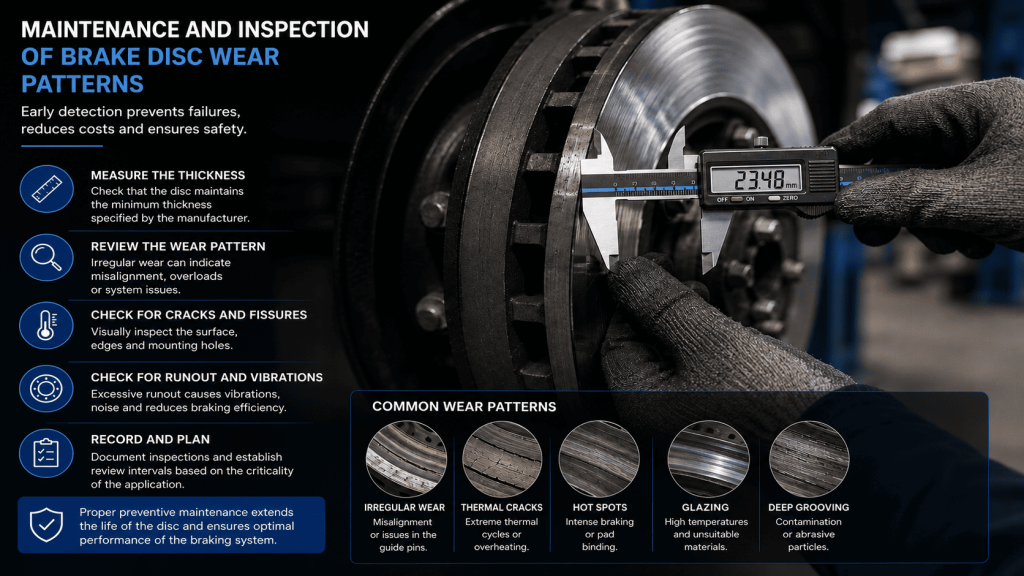
By analysing these indicators early, maintenance teams can identify the root cause of wear rather than simply replacing worn components and repeating the same failure cycle.
Evaluate the Entire Braking System
When premature brake disc wear occurs, replacing the disc alone rarely solves the problem.
The root cause often lies elsewhere in the braking system, whether in the friction material, brake caliper alignment, cooling capacity, operating cycle, or equipment design.
For this reason, engineers should establish clear replacement criteria based on measurable technical parameters such as:
-
Minimum allowable thickness.
-
Maximum runout.
-
Thermal cracking limits.
-
Maximum operating temperature.
-
Number of braking cycles.
Inspection decisions should never rely solely on visual assessment.
The longest brake disc service life is achieved when design, operation, and maintenance are considered from a complete system perspective.
Ultimately, the objective is not simply to minimise component wear, but to ensure safe, stable, and repeatable braking performance throughout the equipment’s entire operating life.
How JABE Helps Maximise the Service Life of Rubber-to-Metal Components and Industrial Brake Discs
In demanding industrial applications, component durability depends on far more than selecting high-quality materials.
Long-term performance is achieved through the combination of intelligent engineering, optimised design, controlled manufacturing processes, and a thorough understanding of the component’s real operating environment.
At JABE, every project begins with a detailed technical assessment of the customer’s application.
Working closely with OEMs, engineering companies, and maintenance teams, we analyse operating conditions to define the optimum component geometry, mechanical characteristics, and material selection for each specific application.
Whether developing rubber-to-metal bonded components or industrial brake discs, we select elastomers and friction materials based on key performance criteria such as:
-
Dynamic fatigue resistance.
-
Operating temperature.
-
Chemical compatibility.
-
Long-term ageing behaviour.
-
Mechanical performance under real service conditions.
Manufacturing quality is equally critical.
We maintain strict control over every stage of production, paying particular attention to the rubber-to-metal bonding process and vulcanisation parameters to ensure maximum adhesion strength, consistency, and durability.
Every component undergoes continuous inspection and quality verification to guarantee dimensional accuracy, repeatability, traceability, and compliance with customer specifications.
By combining engineering expertise with advanced manufacturing capabilities, JABE helps customers improve component performance, reduce wear, minimise maintenance costs, and maximise equipment availability throughout its operational life.
📌Case Study: Optimising a Rubber-to-Metal Mount for Lifting Equipment
A manufacturer of lifting equipment approached JABE after experiencing repeated premature failures of the rubber-to-metal mounts installed in one of its lifting mechanisms.
Although the original components met the specifications established during the design phase, their actual operating conditions proved to be significantly more demanding than initially anticipated.
The equipment performed a high number of operating cycles each day and was subjected to constantly changing dynamic loads caused by frequent acceleration, braking, and variations in the suspended load.
As a result, the rubber-to-metal mounts were exposed to combined compression and shear stresses that accelerated elastomer fatigue and gradually reduced their vibration isolation performance.
Engineering Analysis
Following a detailed assessment of the application’s operating conditions, our engineering team identified several opportunities for improvement.
The investigation showed that:
• The elastomer compound could be optimised to provide greater resistance to dynamic fatigue.
• Stress concentrations were developing in specific areas of the component geometry.
• The stiffness of the assembly could be refined to improve vibration isolation without compromising the stability of the lifting system.
Rather than simply replacing the failed component with an identical part, the focus was placed on identifying and eliminating the root causes of the premature wear.
The Engineering Solution
Based on the analysis, JABE redesigned the component by modifying the elastomer geometry and selecting a compound better suited to the equipment’s actual operating conditions.
At the same time, the rubber-to-metal bonding process was reviewed and optimised to ensure reliable adhesion throughout millions of load cycles.
The objective was not only to increase component durability, but also to deliver more consistent mechanical performance over the entire service life of the equipment.
Results
The redesigned component demonstrated significantly greater stability under real operating conditions, providing:
• Improved resistance to dynamic fatigue.
• More uniform stress distribution.
• Enhanced vibration damping performance.
• Greater long-term reliability.
• Reduced maintenance interventions.
• Longer service life under demanding operating conditions.
This project illustrates an important engineering principle: the longest-lasting solution is rarely achieved by simply selecting a stronger material. It results from understanding the application as a whole and optimising the interaction between design, materials, manufacturing, and operating conditions.